Look Before You Reason: Implicit Visual Thinking
for Efficient Multimodal Reasoning
MVP Lab, Imperial College London
NeurIPS 2026
Abstract
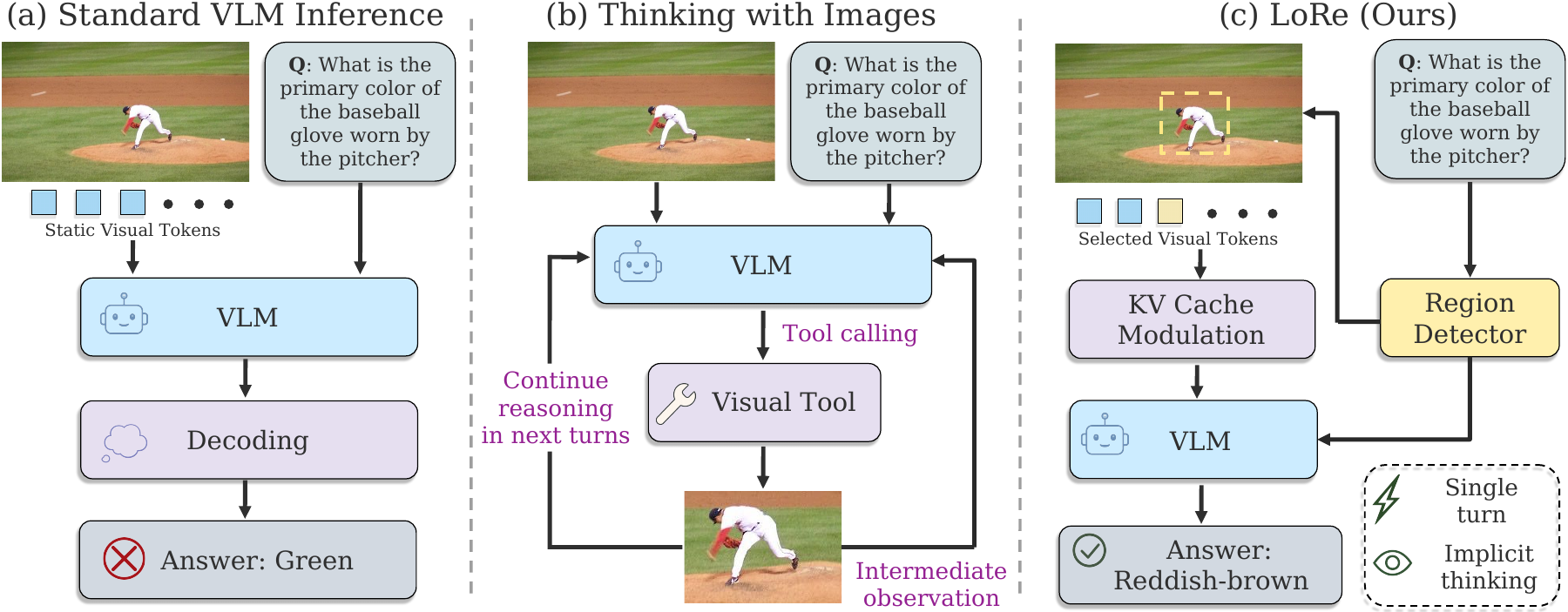
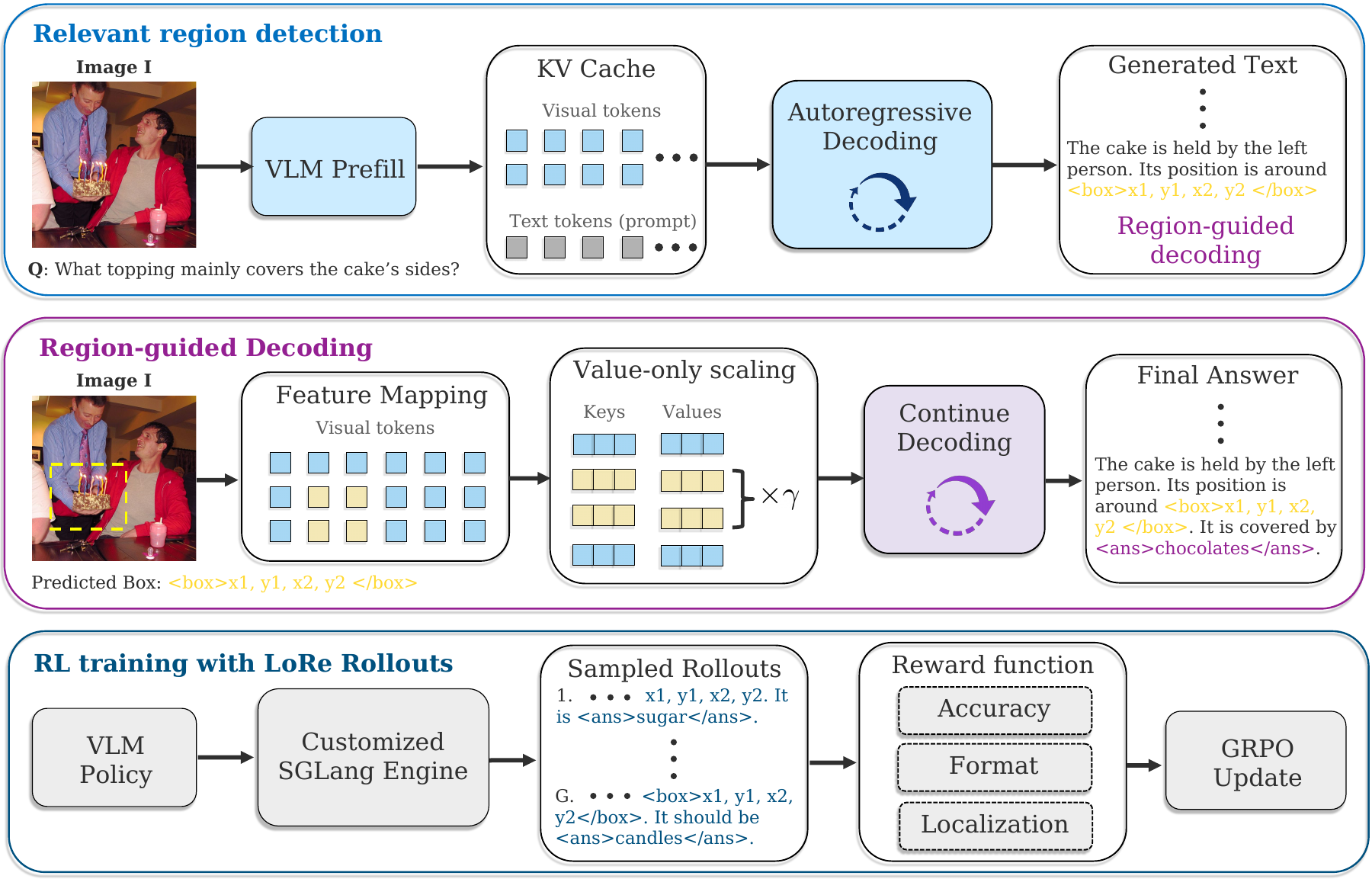
Vision-language models (VLMs) have advanced rapidly in multimodal reasoning, yet they remain limited on tasks requiring fine-grained understanding of small or easily overlooked image regions. Recent thinking with images approaches mitigate this limitation by allowing models to inspect images through operations such as zooming, cropping, or code execution. While effective, their multi-turn interactions with VLMs introduce redundant token computation and slow inference, and separate region inspection from the reasoning step that depends on it. To address these issues, we propose Look Before You Reason (LoRe), an implicit visual thinking framework for efficient visual reasoning within a single-turn VLM interaction. Given an image and a question, LoRe predicts the most relevant image region, aligns it with the corresponding image patch features, and strengthens the associated key-value (KV) cache entries, enabling subsequent decoding to directly exploit the selected visual cues without additional visual inputs or explicit tool calls. We further employ reinforcement learning to guide the VLM toward identifying informative image regions and leveraging them during reasoning. To support fine-grained evaluation of multimodal reasoning, we introduce COCO-ObjQA, a large-scale benchmark for object-centric multimodal reasoning. Experiments on three challenging multimodal benchmarks demonstrate that LoRe consistently improves VLM reasoning performance with low additional inference overhead.
Method Overview
Experimental Results
LoRe improves fine-grained visual reasoning on both Qwen2.5-VL-7B and Qwen3-VL-8B across V*, HR-Bench, and COCO-ObjQA. The comparison below shows the accuracy and inference time of each base model and its LoRe counterpart.
| Model | V* ↑ | HR-Bench ↑ | COCO-ObjQA ↑ | Latency ↓ |
|---|---|---|---|---|
| Qwen2.5-VL-7B | 72.4 | 66.0 | 86.9 | 1.92 |
| LoRe (Qwen2.5-VL-7B) | 82.6 | 73.6 | 91.6 | 2.16 |
| Qwen3-VL-8B | 81.8 | 76.4 | 90.0 | 2.95 |
| LoRe (Qwen3-VL-8B) | 88.6 | 80.2 | 92.7 | 3.06 |
Latency is measured on the same H200 machine with a batch size of one, without an external inference engine. LoRe timings include region parsing and KV cache updates.
Improved small-object reasoning. On the small-object split of COCO-ObjQA, LoRe raises Qwen2.5-VL-7B accuracy from 72.3% to 83.1%, and Qwen3-VL-8B accuracy from 79.2% to 84.3%. These gains highlight the benefit of selecting and strengthening fine-grained visual evidence.
COCO-ObjQA Benchmark
We introduce COCO-ObjQA to evaluate whether VLMs can locate and reason about specific objects within an image. Built from MS COCO instance annotations, it contains 8,537 question-answer pairs from 4,107 images, spanning 80 object categories.
Each multiple-choice question is associated with a target object, allowing evaluation across small, medium, and large objects. Models receive only the original full image and the question with its answer options. Target boxes, crops, and highlighted regions are excluded from the evaluation input, so the benchmark tests whether a model can find the relevant evidence itself.
BibTeX
@inproceedings{chen2026lore,
  title     = {Look Before You Reason: Implicit Visual Thinking for Efficient Multimodal Reasoning},
  author    = {Chen, Zerui and Chen, Changrui and Ni, Fei and Deng, Jiankang},
  booktitle = {NeurIPS},
  year      = {2026}
}
Acknowledgements
We gratefully acknowledge Prof. Stefanos Zafeiriou for his valuable insights and discussions on tiny object perception with multimodal large language models. This work was supported by the Turing AI Fellowship (EP/Z534699/1). Fei Ni was supported by a MSCA Postdoctoral Fellowship. Jiankang Deng was supported by the NVIDIA Academic Grant. The authors gratefully acknowledge the computing resources provided by Isambard-AI, part of the National AI Research Resource (AIRR).
Copyright
The documents contained in these directories are included by the contributing authors as a means to ensure timely dissemination of scholarly and technical work on a non-commercial basis. Copyright and all rights therein are maintained by the authors or by other copyright holders, notwithstanding that they have offered their works here electronically. It is understood that all persons copying this information will adhere to the terms and constraints invoked by each author's copyright.